

The operating platform for automated cell culture.
Design it. Simulate it. Run it. Trace it. Bioflow runs and records every RoboCell operation — and lets scientists design and schedule the next run themselves.
Design-time mistakes surface weeks later.
In most labs the experiment you designed and the workflow that actually runs can differ, and the only way to find out is to run it on live cells.
Translation gap
The experiment you designed and the workflow that runs may differ.
No way to check
Correctness is confirmed only by running it on live cells.
Late consequences
An authoring mistake surfaces on day nine, not at submission.
No cheap practice
Every attempt to learn costs days to weeks.
Mistakes are made at design and discovered on live cells.
Bioflow moves that discovery into software, before a single flask is committed.
Control, and the logic on top of it.
Most lab automation software forces a choice between easy and flexible. Bioflow layers both: the Operator owns the machine, the Scheduler owns the science, and they run on the same RoboCell and the same data.
Control & visibility
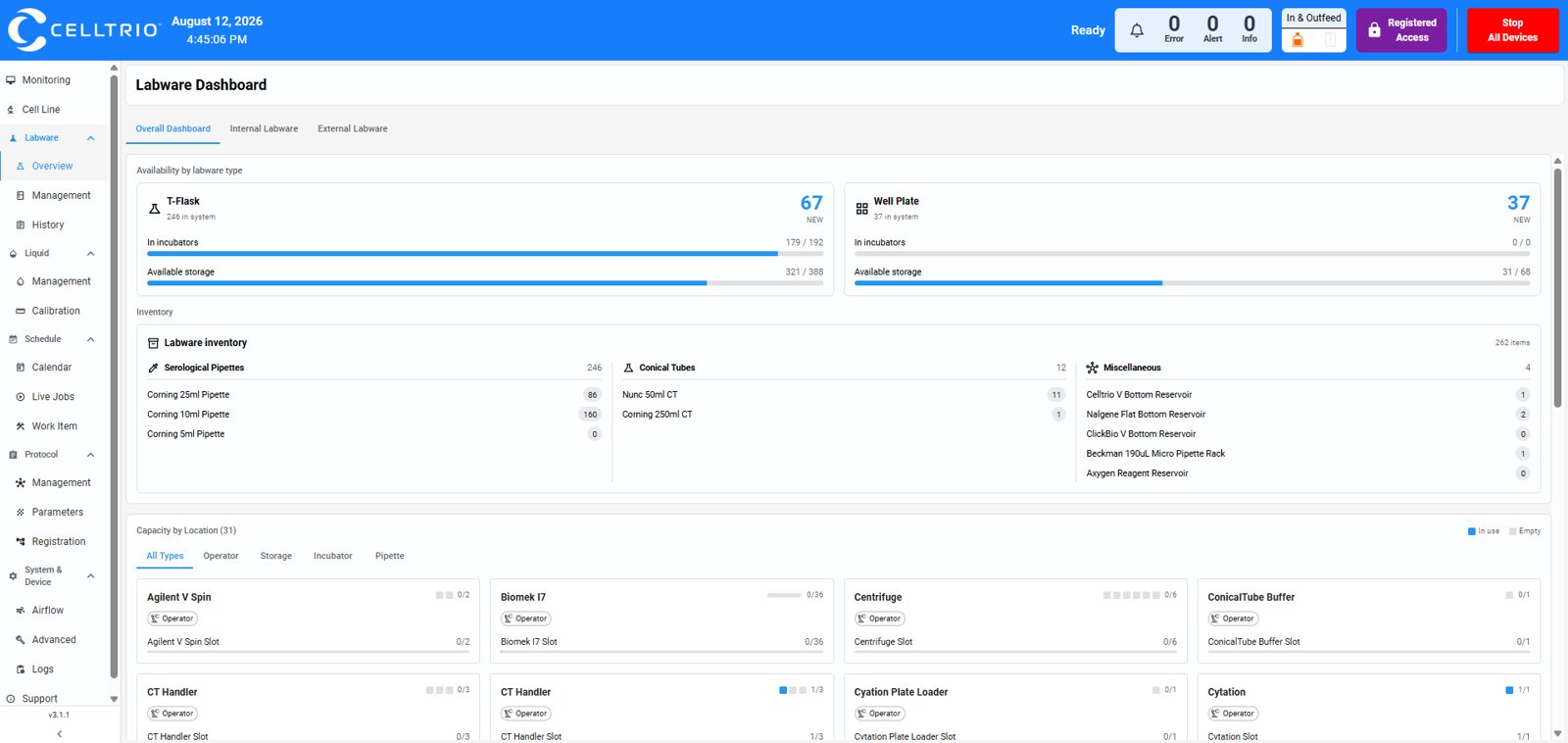
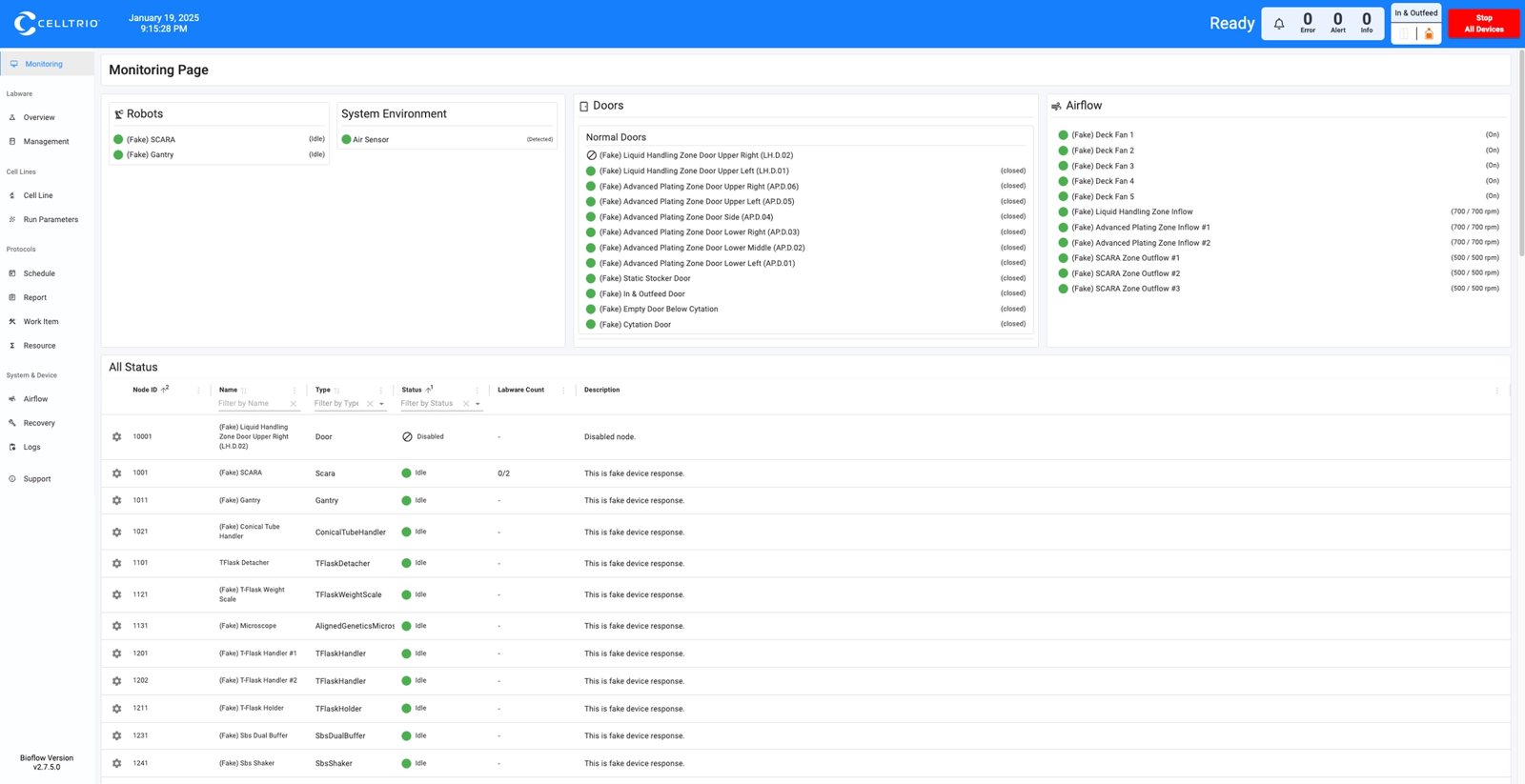
Where control becomes cell culture: see what the system is doing at every level, and act on it.
- Real-time monitoring and system status
- Labware, media, reagent and cell-line inventory
- Environment held against thresholds, with alerts
- Guided error recovery and direct control
- Remote access and monitoring
- Audit trail and sample traceability
Speaks: devices · positions · conditions · faults
Logic on top of machine control
Expresses work in the language scientists use, and turns scientific intent into machine operations.
- Visual, graph-based protocol editor
- Simulation and consistency checks before dispatch
- Job scheduling against real device availability
- Resource estimation and run parameters
- Cross-run data aggregation and analytics
- Lineage and traceability across runs
Speaks: actions · tasks · passages · protocols
The operating system for the robot.
From the moment a run begins, the Operator owns system and device monitoring, storage, environment integrity and fault recovery.
Composed from validated units.
Every procedure is assembled from small, reusable units. That is what keeps authoring approachable without code.
Action
A single atomic action — the smallest step.
Task
Actions grouped into a meaningful operation.
Passage
Tasks sequenced into a repeatable stage of culture.
Protocol
Passages composed into the full procedure a run executes.
Design it. Simulate it. Run it. Trace it.
Scientist-controlled, end to end. What previously required an engineering request is performed directly by the scientist.
Purpose-built for cell culture.
Made for cell culture
Built around cell-culture workflows rather than a repurposed general-purpose lab robot.
Operable by scientists
Protocol authors execute their own runs without an engineer in the loop.
Flexible, not rigid
Protocols adapt to the workflow instead of constraining it.
Scales with process
Designed to connect with upstream and downstream process.
One protocol, from canvas to completed passage.
Protocols are built visually from standard task blocks, checked against a model of your system, and scheduled around everything else already running. Parameters that change per experiment — seeding density, passage ratio, media volume — are exposed as run parameters, not code.
- Graphical workflow development with reusable protocols per cell line
- Process parameters stored or changed on the fly for consistent control
- Results and environmental conditions can direct workflows automatically
Fits the lab you already have
Bioflow exposes an API for job orchestration and labware tracking, and integrates third-party instruments inside the RoboCell enclosure.
Instruments
Beckman Coulter Vi-CELL BLU cell counting, brightfield confluency imaging, liquid handlers, centrifuges, label printers and more, controlled from a single interface.
Schedulers & orchestration
A documented Bioflow API lets external lab schedulers and orchestration platforms start jobs, query labware and receive results.
LIMS, ELN & data
Sample lineage, images, run parameters and environmental logs are exportable for your data platform and analytics pipelines.
Cryogenic storage
RoboStor and its SkyView C3® inventory software integrate directly with RoboCell for closed-loop biobanking.
Remote access
Monitor system status, inventory and environmental conditions from anywhere, with notifications when attention is needed.
Legacy protocols
Our application team helps migrate existing scheduler protocols onto Bioflow’s visual editor as part of every deployment.
Made for regulated labs.
Every action, image and environmental reading is logged against the sample lineage, so a flask’s complete history is always one query away.
21 CFR Part 11
Supports electronic-records and signature needs as compliance matures.
Audit trail
Each run logs operator and system actions and their timing automatically.
Traceable records
Results link back to their protocol, run and materials, with images and environmental logs attached.
Structured export
Records arrive structured for review and reporting, with role-based access control and electronic signatures.
Ask us about validation support (IQ/OQ documentation and compliance configuration) for your site.
RX → DX → AX
Three transformations, one platform. Each stage builds on the data and control foundation of the one before it.
Robotic transformation
Manual lab workflows converted into standardized, enclosed robotic tasks by RoboCell and Bioflow. Rock-solid execution and recovery, run after run.
Digital transformation
Full traceability and continuous aggregation of data and visualization across runs, systems and sites.
AI transformation
Intelligent guidance on protocol design, job scheduling and resulting data — toward a loop that proposes and refines protocols under supervision.
Bring a protocol. Leave with it scheduled.
Live Bioflow walkthrough with an application scientist, on your workflow.